what does it mean when r2 is close to 1
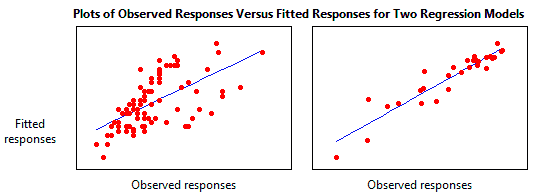
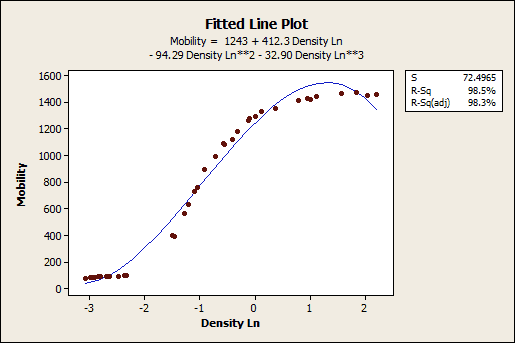
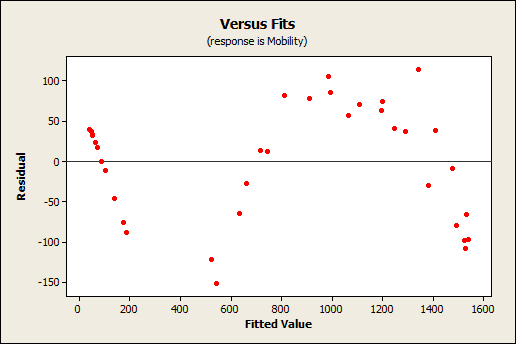
After yous have fit a linear model using regression analysis, ANOVA, or design of experiments (DOE), y'all need to decide how well the model fits the data. To help yous out, Minitab statistical software presents a diverseness of goodness-of-fit statistics. In this post, we'll explore the R-squared (Rtwo ) statistic, some of its limitations, and uncover some surprises forth the mode. For instance, low R-squared values are non always bad and high R-squared values are not always good! Linear regression calculates an equation that minimizes the distance between the fitted line and all of the data points. Technically, ordinary least squares (OLS) regression minimizes the sum of the squared residuals. In general, a model fits the data well if the differences between the observed values and the model'south predicted values are minor and unbiased. Before yous await at the statistical measures for goodness-of-fit, y'all should check the balance plots. Residuum plots can reveal unwanted residual patterns that indicate biased results more effectively than numbers. When your residual plots laissez passer muster, y'all can trust your numerical results and check the goodness-of-fit statistics. R-squared is a statistical measure of how close the information are to the fitted regression line. It is besides known every bit the coefficient of determination, or the coefficient of multiple determination for multiple regression. The definition of R-squared is adequately straight-forrard; it is the pct of the response variable variation that is explained by a linear model. Or: R-squared = Explained variation / Total variation R-squared is ever between 0 and 100%: In general, the college the R-squared, the better the model fits your information. All the same, there are important atmospheric condition for this guideline that I'll talk about both in this mail and my side by side post. Plotting fitted values past observed values graphically illustrates different R-squared values for regression models. The regression model on the left accounts for 38.0% of the variance while the one on the right accounts for 87.4%. The more variance that is accounted for by the regression model the closer the data points will fall to the fitted regression line. Theoretically, if a model could explain 100% of the variance, the fitted values would always equal the observed values and, therefore, all the data points would autumn on the fitted regression line. R-squaredcannot determine whether the coefficient estimates and predictions are biased, which is why you must assess the residual plots. R-squared does not indicate whether a regression model is adequate. You tin can have a low R-squared value for a proficient model, or a high R-squared value for a model that does non fit the data! The R-squared in your output is a biased guess of the population R-squared. No! At that place are two major reasons why information technology can be just fine to accept depression R-squared values. In some fields, it is entirely expected that your R-squared values will be low. For example, whatsoever field that attempts to predict human behavior, such equally psychology, typically has R-squared values lower than 50%. Humans are but harder to predict than, say, physical processes. Furthermore, if your R-squared value is low but you lot have statistically significant predictors, you can even so depict important conclusions nigh how changes in the predictor values are associated with changes in the response value. Regardless of the R-squared, the meaning coefficients nonetheless stand for the mean change in the response for one unit of change in the predictor while holding other predictors in the model constant. Obviously, this blazon of information can exist extremely valuable. See a graphical analogy of why a low R-squared doesn't impact the interpretation of significant variables. A low R-squared is almost problematic when you want to produce predictions that are reasonably precise (have a pocket-size enough prediction interval). How high should the R-squared be for prediction? Well, that depends on your requirements for the width of a prediction interval and how much variability is present in your data. While a high R-squared is required for precise predictions, it's not sufficient by itself, every bit nosotros shall see. No! A high R-squared does non necessarily indicate that the model has a good fit. That might exist a surprise, only wait at the fitted line plot and residual plot below. The fitted line plot displays the relationship between semiconductor electron mobility and the natural log of the density for real experimental information. The fitted line plot shows that these information follow a nice tight function and the R-squared is 98.5%, which sounds swell. However, expect closer to run across how the regression line systematically over and under-predicts the information (bias) at unlike points along the curve. You lot can likewise come across patterns in the Residuals versus Fits plot, rather than the randomness that you want to see. This indicates a bad fit, and serves as a reminder as to why you should always cheque the residual plots. This example comes from my post near choosing between linear and nonlinear regression. In this case, the reply is to apply nonlinear regression because linear models are unable to fit the specific curve that these data follow. However, similar biases tin can occur when your linear model is missing important predictors, polynomial terms, and interaction terms. Statisticians call this specification bias, and it is caused by an underspecified model. For this blazon of bias, you can set the residuals by adding the proper terms to the model. For more data virtually how a loftier R-squared is not always adept a thing, read my post Five Reasons Why Your R-squared Tin Be Likewise High. R-squared is a handy, seemingly intuitive measure of how well your linear model fits a set of observations. However, every bit we saw, R-squared doesn't tell us the entire story. You should evaluate R-squared values in conjunction with residual plots, other model statistics, and subject area expanse cognition in order to circular out the picture (pardon the pun). While R-squared provides an approximate of the strength of the relationship between your model and the response variable, information technology does not provide a formal hypothesis test for this relationship. The F-test of overall significance determines whether this human relationship is statistically significant. In my next web log, nosotros'll continue with the theme that R-squared by itself is incomplete and look at ii other types of R-squared: adjusted R-squared and predicted R-squared. These two measures overcome specific problems in gild to provide additional information by which you can evaluate your regression model's explanatory power. For more than almost R-squared, larn the answer to this eternal question: How loftier should R-squared exist? If you're learning about regression, read my regression tutorial! What Is Goodness-of-Fit for a Linear Model?
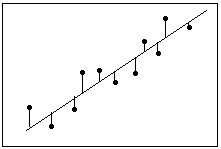 Definition: Residual = Observed value - Fitted value
 What Is R-squared?
Graphical Representation of R-squared

Cardinal Limitations of R-squared
Are Low R-squared Values Inherently Bad?
Are High R-squared Values Inherently Good?
Closing Thoughts on R-squared

waguespacksesom1936.blogspot.com
Source: https://blog.minitab.com/en/adventures-in-statistics-2/regression-analysis-how-do-i-interpret-r-squared-and-assess-the-goodness-of-fit
Belum ada Komentar untuk "what does it mean when r2 is close to 1"
Posting Komentar