west florida tried to become part of what other state
European Exploration and Colonization
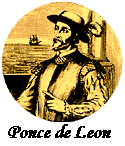 Written records about life in Florida began with the arrival of the Spanish explorer and adventurer Juan Ponce de León in 1513. Former between April two and April eight, Ponce de León waded ashore on the northeast declension of Florida, possibly about nowadays-day St. Augustine. He called the surface area la Florida, in honour of Pascua florida ("feast of the flowers"), Espana's Eastertime celebration. Other Europeans may have reached Florida earlier, but no firm evidence of such achievement has been constitute.
On another voyage in 1521, Ponce de León landed on the southwestern coast of the peninsula, accompanied past two-hundred people, fifty horses, and numerous beasts of burden. His colonization endeavour chop-chop failed because of attacks past native people. However, Ponce de León's activities served to place Florida as a desirable place for explorers, missionaries, and treasure seekers.
In 1539 Hernando de Soto began another expedition in search of gold and silver, which took him on a long trek through Florida and what is now the southeastern United States. For four years, de Soto's expedition wandered, in hopes of finding the fabled wealth of the Indian people. De Soto and his soldiers camped for five months in the expanse now known equally Tallahassee. De Soto died nigh the Mississippi River in 1542. Survivors of his expedition eventually reached Mexico.
No great treasure troves awaited the Castilian conquistadores who explored Florida. However, their stories helped inform Europeans about Florida and its relationship to Republic of cuba, Mexico, and Cardinal and Due south America, from which Spain regularly shipped gold, silver, and other products. Groups of heavily-laden Castilian vessels, called plate fleets, usually sailed up the Gulf Stream through the straits that parallel Florida's Keys. Enlightened of this road, pirates preyed on the fleets. Hurricanes created additional hazards, sometimes wrecking the ships on the reefs and shoals along Florida'due south eastern coast.
In 1559 Tristán de Luna y Arellano led some other endeavour by Europeans to colonize Florida. He established a settlement at Pensacola Bay, but a serial of misfortunes caused his efforts to be abandoned later on two years.
Espana was not the only European nation that found Florida bonny. In 1562 the French protestant Jean Ribault explored the area. Two years later, fellow Frenchman René Goulaine de Laudonnière established Fort Caroline at the mouth of the St. Johns River, near present-day Jacksonville.
First Spanish Period

These French adventurers prompted Spain to accelerate her plans for colonization. Pedro Menéndez de Avilés hastened beyond the Atlantic, his sights set on removing the French and creating a Spanish settlement. Menéndez arrived in 1565 at a place he called San Augustín (St. Augustine) and established the first permanent European settlement in what is at present the United States. He accomplished his goal of expelling the French, attacking and killing all settlers except for non-combatants and Frenchmen who professed conventionalities in the Roman Catholic faith. Menéndez captured Fort Caroline and renamed information technology San Mateo. 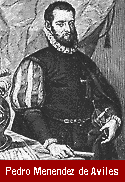
French response came two years later, when Dominique de Gourgues recaptured San Mateo and made the Spanish soldiers stationed in that location pay with their lives. Nevertheless, this incident did non halt the Spanish advance. Their pattern of amalgam forts and Roman Catholic missions connected. Spanish missions established amongst native people shortly extended across north Florida and every bit far north along the Atlantic coast as the surface area that nosotros now call Southward Carolina.
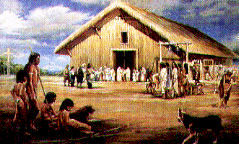 The English, also eager to exploit the wealth of the Americas, increasingly came into conflict with Kingdom of spain's expanding empire. In 1586 the English helm Sir Francis Drake looted and burned the tiny village of St. Augustine. However, Castilian control of Florida was non diminished.
In fact, as late as 1600, Espana'south power over what is now the southeastern United States was unquestioned. When English settlers came to America, they established their first colonies well to the North–at Jamestown (in the present state of Virginia) in 1607 and Plymouth (in the present state of Massachusetts) in 1620. English colonists wanted to take advantage of the continent's natural resources and gradually pushed the borders of Spanish power southward into present-twenty-four hours southern Georgia. At the same time, French explorers were moving down the Mississippi River valley and eastward forth the Gulf Coast.
The English colonists in the Carolina colonies were particularly hostile toward Spain. Led by Colonel James Moore, the Carolinians and their Creek Indian allies attacked Castilian Florida in 1702 and destroyed the boondocks of St. Augustine. However, they could not capture the fort, named Castillo de San Marcos. Two years later, they destroyed the Spanish missions between Tallahassee and St. Augustine, killing many native people and enslaving many others. The French connected to harass Castilian Florida'south western border and captured Pensacola in 1719, twenty-one years after the town had been established.
Espana's adversaries moved fifty-fifty closer when England founded Georgia in 1733, its southernmost continental colony. Georgians attacked Florida in 1740, assaulting the Castillo de San Marcos at St. Augustine for almost a month. While the attack was not successful, information technology did point out the growing weakness of Spanish Florida.
British Florida
Britain gained control of Florida in 1763 in exchange for Havana, Cuba, which the British had captured from Spain during the 7 Years' War (1756–63). Espana evacuated Florida afterwards the substitution, leaving the province most empty. At that fourth dimension, St. Augustine was notwithstanding a garrison community with fewer than five hundred houses, and Pensacola too was a small armed services town.
The British had ambitious plans for Florida. First, it was separate into 2 parts: East Florida, with its capital letter at St. Augustine; and Westward Florida, with its seat at Pensacola. British surveyors mapped much of the landscape and coastline and tried to develop relations with a grouping of Indian people who were moving into the area from the North. The British chosen these people of Creek Indian descent Seminolies, or Seminoles. Britain attempted to concenter white settlers by offering land on which to settle and help for those who produced products for export. Given enough time, this plan might have converted Florida into a flourishing colony, but British rule lasted but twenty years.
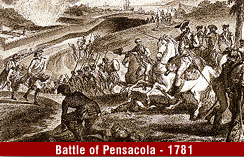 The two Floridas remained loyal to U.k. throughout the State of war for American Independence (1776–83). However, Spain–participating indirectly in the war as an ally of French republic–captured Pensacola from the British in 1781. In 1784 it regained control of the rest of Florida as office of the peace treaty that ended the American Revolution.
2d Spanish Menstruation
When the British evacuated Florida, Castilian colonists as well as settlers from the newly formed The states came pouring in. Many of the new residents were lured past favorable Castilian terms for acquiring property, called country grants. Others who came were escaped slaves, trying to reach a identify where their U.S. masters had no dominance and finer could not attain them. Instead of becoming more Spanish, the 2 Floridas increasingly became more than "American." Finally, later on several official and unofficial U.Due south. military expeditions into the territory, Spain formally ceded Florida to the The states in 1821, co-ordinate to terms of the Adams-Onís Treaty.
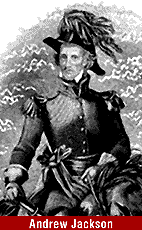 On 1 of those military operations, in 1818, General Andrew Jackson made a foray into Florida. Jackson's battles with Florida'southward Indian people afterward would be called the Kickoff Seminole War.
waguespacksesom1936.blogspot.com
Source: https://dos.myflorida.com/florida-facts/florida-history/a-brief-history/european-exploration-and-colonization/
Belum ada Komentar untuk "west florida tried to become part of what other state"
Posting Komentar