Telling Patents Youre Pregnant With a Boyfriend They Dont Likes Baby
W hen Jenica Anderson and Stephan DuVal clicked on one another'due south online profile on Modamily.com – tagline "A new way to family" – neither was looking for romance. They were both in their late 30s, and their brusk bios indicated that they shared like views on wellness and pedagogy, had solid incomes and were searching for the same thing: a non-romantic partner to have – and heighten – a child with. A co-parent.
Anderson, 38, a geologist from Montana, US, had matched with and spoken to 10 different men, mostly via then-chosen mating sites – matchmaking sites for people who want a baby without a romantic human relationship – when she had her first phone call with DuVal, from Vancouver, Canada, in bound 2019. Their conversations quickly started to see the night and, that June, she flew out to spend the weekend with him. They talked, went hiking and jumped into a lake together. "It felt like a engagement," says DuVal, 37, a camera operator. "Except we could be totally honest about wanting to have a kid soon, without the goofiness and flirting of a first date. You're looking to achieve a common goal."
In a world where biological science and equal rights take diversified means to kickoff a family, platonic co-parenting – the decision to have a kid with someone you are not romantically involved with and, in most cases, choose not to live with – remains a relatively new miracle.
Well established in gay communities, forth with egg and sperm donation, information technology is on the rise amid heterosexual singles. Tens of thousands have signed upwards to matchmaking sites at a toll of around £100 a year. On Coparents.co.uk, which launched in Europe in 2008, two-thirds of its 120,000 worldwide members are straight. Modamily, which launched in LA in 2012, has 30,000 international members, of whom 80% are straight and 2,000 are British. U.k.-based competitor PollenTree.com has 53,000 members, separate 60/40 women to men, and ranks its domestic marketplace equally its strongest. During lockdown, the latter two sites reported traffic surges of 30-50%.
Prof Susan Golombok, managing director of the Academy of Cambridge's Centre for Family Research and writer of Nosotros Are Family, a new book examining the wellbeing of children in structures beyond the nuclear unit, has researched new family forms since the 1980s. She has studied families created via IVF, sperm and egg donation, and surrogacy, equally well as lesbian female parent families, gay father families and single mothers past option.
Golombok'due south squad turned their attention to constituent co-parenting equally an emerging tendency in 2015. They are at present post-obit l families in what they believe to be the earth's outset study considering the impact of the arrangement on children.
She says: "It was a gradual realisation that this was a new phenomenon picking upwards speed. The primary question for united states is how does this relationship between parents, where there is no romantic relationship, develop, with each other and the child? Is the relationship breakdown rate higher or lower? Very early findings suggest that how well the parents communicate with each other and collaborate over childcare seems to make a big deviation."
The quality of parents' relationships with one some other, and their level of intimacy, has a big begetting on children's welfare, she says. "It is possible, though, that taking away romantic luggage could even make for a more than stable surround."
Anderson already had a young son – she split from his male parent when he was 1. She signed up to two websites in early 2019. She wanted the opportunities that having ii parents in a child'due south life could bring. Even so, she lived in a modest community where in that location was no one willing to enter into a co-parenting arrangement, and had already considered and dismissed men she had dated before.
"I really didn't desire a romantic connectedness; I thought it would convolute things," she says. "I'd seen the traditional recipe not work out. [Stephan and I] had a shared sense of direction – raising a happy child who makes information technology through life OK. My ex and I are very amicable co-parents, and that showed me there were real strengths to doing it this way. I wanted to tap into the stuff that'southward adept for the child – a functional dynamic and a stable life. Stephan and I asked ourselves, 'Can nosotros be allies and ensure that whatsoever future kid gets the best?' If it was only near parenting, nosotros could remain pragmatic. I wanted to abound my family with somebody who wanted to be a adoring father and wasn't just having a baby for me."
Her parents weren't and so convinced. "I'one thousand pretty sure [they] lost a lot of sleep over what I was doing. My father worried about finances. On some level, they probably worried near the morality."
More than 800 miles away, DuVal, frustrated by his efforts to encounter someone who shared his want for children, had as well subscribed to Modamily. "I wanted a child to give life more significant; a lot of people I know are married to their jobs," he says. "I hoped that, maybe, I'd notice romance eventually, but [for me] information technology was time to start a family."
He met three other possible matches before connecting with Anderson. He admired her bravery, parenting fashion and family unit ties. "The big fear was that I'd match with someone who turns out to be a terrible man. But my fear quickly disappeared. Nosotros spoke a lot about kid-raising scenarios. Nosotros were frequently on the same page. We talked about our own lives, what shaped us, past relationships."
Anderson was drawn to his sense of adventure and flexibility. She says: "If unpredictable things came our fashion, [I felt] he could adapt. He had great dad qualities. I quickly felt confident in this really unknown and anarchistic partnership."
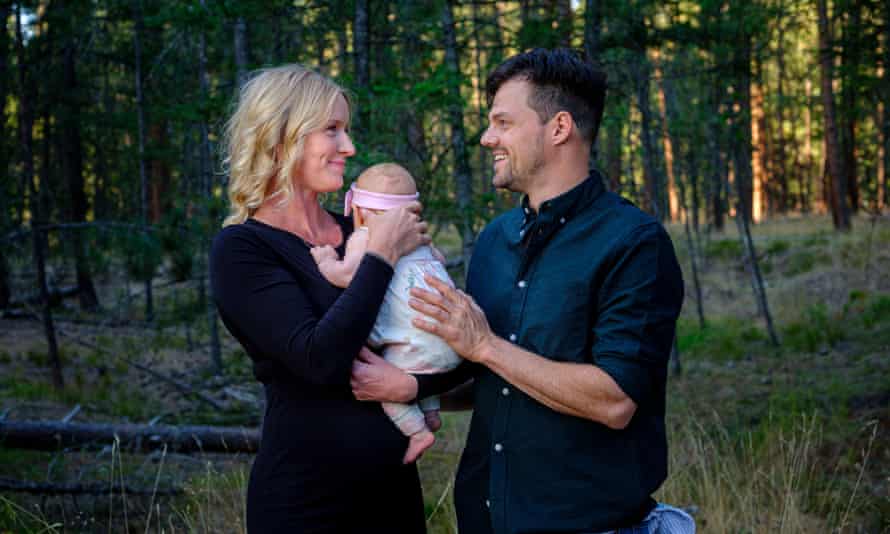
By the end of that June weekend, they returned to their lives having plant the person they wanted to parent with. By September, they had conceived – naturally – and were pregnant. "Going into this, I presumed getting significant would exist clinical, just one time we spent time together we decided to effort naturally," says Anderson. "I tracked my ovulation, and we cruel pregnant during a road trip on the west declension." (Most co-parenting partnerships either have sex or choose the "turkey baster" method of artificial insemination at home. Some choose IVF.)
A yr after their start meeting, their daughter was born.
A s Golombok's team were noticing the ascent of this new family unit of measurement, Oliver and Kate were imagining what their ain might await like. Oliver had tried for years to accept a babe in his former relationship. In his 40s, the human relationship ended, simply his want to get a dad did not, and he logged on to The Stork, a London-based site which has been responsible for 15 babies since it started matchmaking "people gear up to be parents" v years ago.
"Then many of my mates had children and ended upwards with disastrous, costly divorces, simply seeing their kids irregularly," says Oliver. "I idea it would be better to get on with somebody as a mate and take a baby without wasting time."
He was introduced to Kate, and they scored 93% in a compatibility examination through the bureau, which sits at the top cease of the market, charging £4k-£10k for its bespoke membership packages. These include Plan A, for prospective parents hoping to find romance, too, and Program B, for those just wanting to co-parent. Oliver and Kate embarked on Plan A, but, after a few dates, and going to bed together, rapidly switched to the platonic option.
"Nothing blossomed romantically," says Oliver. "Just our principles for raising a child were the same – fun and spontaneity; not likewise indulgent; education was important. Information technology felt straightforward. Kate takes me every bit I am. She is compromising, undemanding and piece of cake to deal with."
Kate says: "I prepare out to meet someone I'd exist with for ever, but I was in my tardily 30s, time was ticking, my fertility was not that great, and having a kid was very important to me. Oliver's kind and gallant; he would protect us both. We got on extremely well."
Kate became pregnant four months after. As she and Oliver had already slept together in the early on weeks of dating, having sex to try for their baby felt similar the obvious arroyo. "During the pregnancy, we did all the things you lot would with a regular, long-term partner: scans, shopping for infant stuff, texts when the baby kicked," says Oliver. "I was at the nascence, too."
But information technology was not entirely straightforward. Fearful of the prejudice that co-parenting families frequently confront, Oliver and Kate (not their real names) have, to this solar day, pretended to family unit and friends that they were in a human relationship from when they met until their son was 18 months former.
Kate says: "Oliver moved into my spare room until nosotros faked splitting up. It was a farce. Both our families are quite conservative. Even at present, merely one or ii friends know the truth. We should be able to live our lives without fear of judgment, but the reality is that having a child through a one-night stand probably feels more than acceptable to people than this."
Oliver adds: "People are judgmental about changing the course of reproduction, manufacturing a family unit, fifty-fifty when the typical way often doesn't work out."
Now aged four, their son spends every other weekend and 1 night a calendar week at his dad's; the pair live within an hour's drive of each other. They keep family days out, and spend Christmas and birthdays together. Both describe their relationship now as one akin to best mates.
"We're always laughing," says Kate. "We're on the same wavelength, and our priority is our son, who is an appreciating, physical, happy little boy. We respect each other. When Oliver picks him up or drops him off, he comes in for tea; I know plenty of divorced couples where the dad sits exterior in the motorcar. We both believe that men and women bring different things to a kid's life."
Both at present have new partners, who have children from previous relationships. Oliver says: "There'due south none of the antagonism that often comes with exes. We all spent last Christmas together; there were seven children there. I hope our son sees [in his parents] a bang-up bond betwixt two people who give him the beloved and support he needs. Nosotros will explain that to him as he grows up."
Had she been 29, Kate says she might not have chosen this path to parenthood, but she adds: "I think there are far worse ways to bring a child into this world. I've got my infant and the dear of my life, merely through two different men. Our son doesn't run into mummy and daddy kissing and cuddling in the aforementioned house, but he sees that he'due south loved and wanted, very much, past both of us."
U nlike surrogacy, for case, which has percolated into the public consciousness, partly thanks to celebrities such every bit Elton John and Kim Kardashian Westward, platonic co-parenting remains petty understood and less spoken nigh. Sites are overrepresented by members working in the media, senior civil service, law, medicine and banking, where privacy is prized, says Patrick Harrison, founder of PollenTree.com.
"There are a lot of people in this land who probably don't share a view that it'south a great thing, and they can be song," he says. "Our members keep a depression profile because information technology'southward nobody else'due south business. They don't need the rest of club to tell them it's a good or bad thing."
These concerns may not exist completely unfounded, says Golombok, but at that place are upsides. "People still see the traditional family as the golden standard, and every other kind is measured against that. But the overarching finding of our research, over 40 years, is that these are well-adjusted families, sometimes more and then than traditional ones. These are wanted children. The biggest concern is whether these children might exist stigmatised, judged or bullied because of their family."
Golombok writes in her volume: "From our studies of new family forms that have emerged since the 1970s –– families that were considered threatening and objectionable when they first appeared –– it seems likely that many of the fears about future families will turn out to be unjustified."
Despite the many changes in family makeup over recent decades, Golombok says it is hard to know, all the same, whether elective co-parenting volition go commonplace. It is not without difficulty and, equally with any relationship, these partnerships can break down, too.
Amy, 37, had her daughter, Emma, six years ago after approaching a friend of almost a decade to raise a child together. They both longed to exist parents, shared views on healthcare and schooling, and lived fifteen minutes autonomously, in California. They talked over their programme for three months, before falling pregnant at the first attempt.
She says: "For years, I wanted the big love. I ended up with a very broken heart, but nevertheless wanted a infant. I could have paid $500 at the sperm depository financial institution, merely I was pretty sure I could do it for free. If I couldn't take the large dream, this felt similar the adjacent all-time thing." The sex, she says, was "something I had to get a flake drunk for. I was so determined to brand a infant, though – I was a woman on a mission. I did 'savour' information technology, but I wouldn't do it again with someone I didn't really want to accept sex with, fifty-fifty for a baby."
While Amy'south female parent was excited well-nigh having a grandchild, her father thought information technology was an "atrocious" selection. "Friends of friends would tell each other they were outraged I was 'starting from a broken dwelling house'," she remembers.
When Emma was a newborn, Amy's co-parent slept on her sofa to help with night feeds. Every bit she grew, they established 50/50 parenting, working opposite ends of the twenty-four hour period then both enjoyed daily time with their daughter. "There were moments when I idea 'Thank God for him'," she says.
"I had an admissible policy. I organised family unit photos, pumpkin picking on Halloween, and we spent Christmas and Thanksgiving together. I hoped my child would accept a loving, engaged mother and father. We had our social, dating and professional person lives; she had two families who love her. It seemed to work well."
Simply, speaking days after mediation in a custody battle she describes every bit "the biggest imaginable nightmare", Amy now recognises that cracks appeared before Emma was born.
"Having sex to conceive was probably disruptive for us both. There was a shift. He started calling me 'hun' and 'babe'. He was hoping for a human relationship," she says. Boundaries became a source of tension. "We went to therapy together shortly after [Emma] was born. My big fear was being separated from her; his was existence left out."
In the U.k., co-parents tin depict up a private agreement of terms, but the paperwork is unenforceable in court – in a custody battle, a gauge would only consider what was in the all-time interests of the child.
"If someone was to say now, 'Should I co-parent?' I'd say, 'Absolutely non,'" says Amy. "People used to ask me how I'd protect myself: yous tin't. I accept a gorgeous, smart, empathic daughter, but it'due south much like going through a divorce. The whole indicate of co-parenting was to avoid that."
She adds: "I experience a lot of shame because I chose this. I thought I could make it piece of work. Looking back, I wonder if I really felt my kid needed a father, or whether that was societal pressure?"
It is impossible to calculate how many children take been born this way; bigger websites unscientifically judge that they take been responsible for about 1,000 births each.
In their 2015 study Friendly Allies, Golombok's Cambridge team found that the main motivation for seeking a co-parent online was wanting a child to know both biological parents. Others included business organisation about getting older, and sharing the financial price of parenting.
Sites invest a great deal in moderation, to eliminate scammers. For example, if a man using PollenTree specifies natural insemination only, he is treated with suspicion and his profile is airtight downwards. "The stakes are very high, and we demand to sleep at dark," says Harrison.
LA-based Ivan Fatovic worked in flick and Tv earlier he founded Modamily in 2012, after a conversation with a group of girlfriends tiring of the dating game. The site's first baby was born the following twelvemonth. Members pay $29.99 a month (£23), and are asked to rank what they value in a co-parent. They are matched past algorithms; fields include income, health, creativity and physical appearance. A bespoke concierge service, where the site vets potential matches for you, is available for $2,000-ten,000 (£1,550-£seven,750).
"Tinder caters for 18- to 25-year-olds; nosotros cater for people in their 30s and 40s," says Fatovic. "On a starting time date, saying, 'I want three kids in the next five years', is not something people, especially men, want to hear. [But] everyone on the site is thinking about having a child sooner or afterwards. The divorce rate means that living in two separate homes, when mom and dad might have new partners, is not unusual. Modernistic arrangements, like Gwyneth Paltrow and Chris Martin'south 'conscious uncoupling' were already happening, there simply wasn't a name for information technology.
"People have started to recognise that the person you have kids with may non be the person you grow old with – but they yet desire the influences of both a mother and male parent in their kid'due south life. They want that consistency, fiscal help and support organisation."
Like The Stork, Modamily too features a romance option, for those searching for a long-term partner too. "I find when ii straight people meet on the site it oftentimes goes down the romance path," says Fatovic.
A nderson and DuVal may not accept clicked for dearest – but it followed anyway. Past the time they said goodbye later on that beginning weekend by the lake, in that location were the makings of deeper feelings. By the time Anderson was meaning three months after, they were a couple, despite her intentions to the opposite.
"Ultimately, I ended up falling for Stephan for the same reason I chose to parent with him: information technology was piece of cake to communicate, share information, exist honest and vulnerable with i another," she says.
"She'southward the outset daughter my parents met in a decade," adds DuVal.

They welcomed their daughter into the world on a sunny, mid-June solar day in Montana, where they've made their family domicile. They remain a couple, simply wherever their romance takes them, parenting together remains their priority. "I think information technology's possible to go into this without falling in love, just there are benefits of having fallen for each other," says DuVal. "Without that, there would have been all these moments during the pregnancy, when I wasn't needed, that I'd have missed. I wanted to exist effectually and she wanted me there.
"Everyone asks how we met. If I don't know them well, I just say 'online'. If I had to date again, I would commencement in the open and honest fashion we did. It's a stronger foundation."
Gazing on her expanded family unit in the warmth of their newborn bubble, Anderson says she takes none of information technology for granted. "We have these ideas of what relationships or romance look similar. I think deciding to co-parent is, in some ways, falling in honey with someone – even if information technology'due south not a romantic love."
Names and some identifying details have been inverse. Nosotros Are Family by Susan Golombok is published past Scribe at £16.99.
Comments on this slice are premoderated to ensure the give-and-take remains on the topics raised by the article. Delight exist aware that there may exist a brusque delay in comments appearing on the site.
waguespacksesom1936.blogspot.com
Source: https://www.theguardian.com/lifeandstyle/2020/oct/31/i-wanted-to-meet-a-mate-and-have-a-baby-without-wasting-time-the-rise-of-platonic-co-parenting
Belum ada Komentar untuk "Telling Patents Youre Pregnant With a Boyfriend They Dont Likes Baby"
Posting Komentar